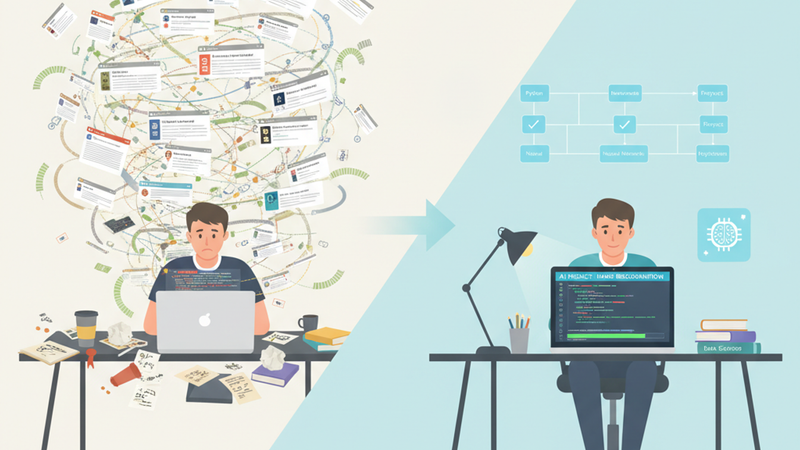
The world of Artificial Intelligence can feel like a labyrinth. Every day, new tools, libraries, and concepts emerge, making it incredibly hard for beginners to figure out where to start. If you're a student or a fresher in India looking to learn AI from scratch, you're not alone in feeling this confusion. This guide cuts through the noise to give you a clear, actionable roadmap to master AI in 2026.
This isn't just about theory; it's about building practical skills that employers value. We'll cover everything from foundational programming to advanced AI concepts, project development, and career preparation. No hype, just a straightforward path.
The Essential AI Learning Roadmap for Beginners
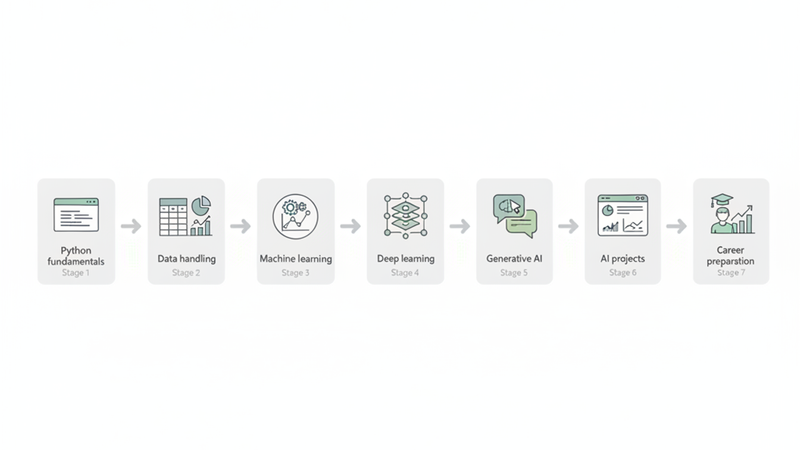
Learning AI is a journey, not a sprint. It requires a structured approach, building one skill upon another. Here's your step-by-step AI learning roadmap:
Step 1: Master Python Fundamentals (Weeks 1-3)
Python is the lingua franca of AI. Before you dive into complex algorithms, you need a solid grasp of its basics. Don't skip this. It's the foundation upon which everything else is built.
What to learn:
Syntax and Data Types: Variables, strings, integers, floats, booleans.
Control Flow:if-else statements, for loops, while loops.
Data Structures: Lists, tuples, dictionaries, sets. Understand when to use each.
Functions: Defining and calling functions, arguments, return values.
Object-Oriented Programming (OOP) Basics: Classes, objects, methods, attributes. This becomes crucial for larger projects.
File I/O: Reading from and writing to files.
Error Handling:try-except blocks.
How to learn: Interactive coding platforms (like HackerRank or LeetCode), online courses, and practice, practice, practice. Solve at least 2-3 coding problems daily.
Step 2: Grasp Data Handling and Manipulation (Weeks 4-6)
AI is all about data. Before you can build models, you need to know how to collect, clean, and prepare your data. This is often 80% of an AI professional's work.
What to learn:
NumPy: The fundamental package for numerical computation in Python. Essential for array operations.
Pandas: The go-to library for data manipulation and analysis. Learn DataFrames inside out – filtering, grouping, merging, cleaning missing data.
Matplotlib/Seaborn: Libraries for data visualization. Being able to visualize data helps you understand patterns and communicate insights.
How to learn: Work through tutorials focused on real-world datasets. Try cleaning a messy CSV file, performing aggregations, and creating various plots.
Step 3: Dive into Machine Learning Basics (Weeks 7-12)
This is where you start building intelligence into your systems. Begin with supervised learning, then move to unsupervised learning.
What to learn:
Fundamentals: What is ML? Supervised vs. Unsupervised Learning, Regression vs. Classification.
Key Algorithms (Supervised):
Linear Regression: For predicting continuous values.
Logistic Regression: For binary classification.
Decision Trees & Random Forests: Powerful, interpretable models.
Support Vector Machines (SVMs): Effective for classification tasks.
Key Algorithms (Unsupervised):
K-Means Clustering: For grouping similar data points.
Model Evaluation: Metrics like accuracy, precision, recall, F1-score for classification; MSE, RMSE, R-squared for regression. Understand overfitting and underfitting.
Scikit-learn: The most popular Python library for traditional ML. Learn its API for training, predicting, and evaluating models.
How to learn: Focus on understanding the intuition behind each algorithm, not just memorizing formulas. Implement simple versions of these algorithms from scratch (conceptually, not for production) and then use scikit-learn for practical applications. Work on small datasets from Kaggle.
Step 4: Explore Deep Learning Fundamentals (Weeks 13-18)
Deep learning, a subset of machine learning, powers many of today's most advanced AI applications, especially in areas like image recognition and natural language processing.
Backpropagation: The core algorithm for training neural networks (understand the concept).
TensorFlow / Keras or PyTorch: Choose one framework and get comfortable with it. Keras (part of TensorFlow) is often recommended for beginners due to its user-friendliness.
Convolutional Neural Networks (CNNs): For image processing tasks.
Recurrent Neural Networks (RNNs) / LSTMs: For sequential data like text or time series.
How to learn: Start with simple image classification tasks (e.g., MNIST dataset). Build and train your first CNN. Experiment with different architectures and hyperparameters. The goal here is to get hands-on experience with a deep learning framework.
Step 5: Understand Generative AI & Prompt Engineering (Weeks 19-22)
Generative AI (GenAI) is transforming industries. As a beginner, understanding how to interact with and leverage these models is a crucial skill for 2026.
What to learn:
Introduction to GenAI: What are LLMs, diffusion models, and their applications?
Prompt Engineering Principles: How to craft effective prompts for models like GPT-3/4, Gemini, Llama 2.
Practical Usage: Using APIs (e.g., OpenAI API, Hugging Face Transformers) to integrate GenAI into simple applications.
How to learn: Experiment directly with publicly available GenAI models. Read prompt engineering guides. Try to build a small application that uses a GenAI model for text generation, summarization, or image creation.
Step 6: Build Your AI Project Portfolio (Weeks 23-30)
Theory is good, but projects are what truly solidify your learning and showcase your skills to potential employers. This is non-negotiable.
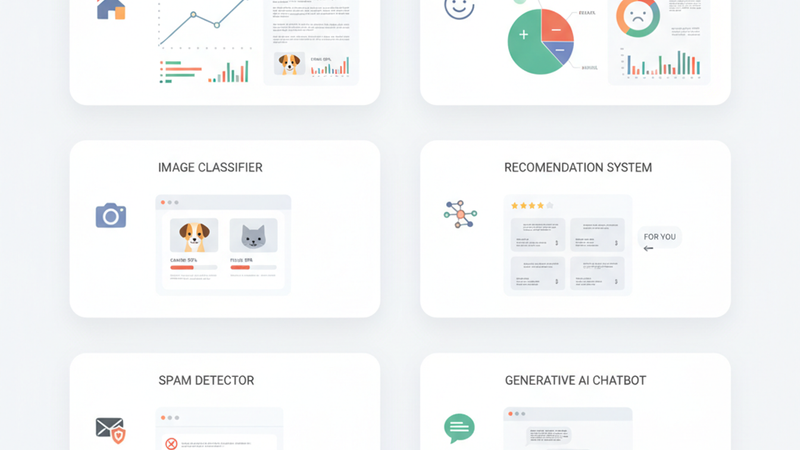
Project Ideas for Beginners:
Predictive Model: Build a model to predict house prices, customer churn, or stock prices (using public datasets).
Image Classifier: Create a CNN to classify images (e.g., cats vs. dogs, types of flowers).
Sentiment Analyzer: Develop an NLP model to determine the sentiment of movie reviews or tweets.
Spam Detector: Build a machine learning model to classify emails as spam or not spam.
Recommendation System: A basic collaborative filtering or content-based recommender for movies or products.
GenAI Application: A simple chatbot, a content summarizer, or an image generator based on text prompts.
Tips for Projects:
Start Small: Don't aim for the next ChatGPT on your first project. Focus on completing a functional project.
Document Everything: Use Jupyter Notebooks or detailed comments. Explain your thought process.
Version Control: Learn Git and GitHub. It's essential for collaboration and showcasing your code.
Deploy (Optional but Recommended): Even a simple deployment to a free platform like Streamlit or Hugging Face Spaces can make your project shine.
Step 7: Prepare for Your AI Career (Ongoing)
Learning AI is one thing; getting a job is another. Proactive career preparation is key.
Networking: Connect with AI professionals on LinkedIn. Attend virtual meetups or webinars.
Resume/CV Building: Tailor your resume to highlight your AI projects, skills, and relevant coursework.
Interview Preparation: Practice coding challenges, machine learning concepts, and behavioral questions.
Stay Updated: AI is a fast-evolving field. Follow leading researchers, blogs, and conferences.
Common Mistakes Beginners Make (and How to Avoid Them)
Tutorial Hell: Watching endless tutorials without coding yourself. Solution: Code along, then immediately apply what you learned to a new problem.
Skipping Math: While you don't need a PhD in math, a basic understanding of linear algebra, calculus, and statistics is crucial for truly understanding ML algorithms. Solution: Supplement your learning with beginner-friendly math resources (e.g., Khan Academy).
Aiming for Perfection: Getting stuck trying to build the most complex model. Solution: Start with simple models, get them working, then iterate and improve.
Not Building Projects: Relying solely on theoretical knowledge. Solution: Every new concept you learn, try to implement it in a small project.
Learning in Isolation: Not seeking help or feedback. Solution: Join online communities, participate in forums, and seek out mentors.
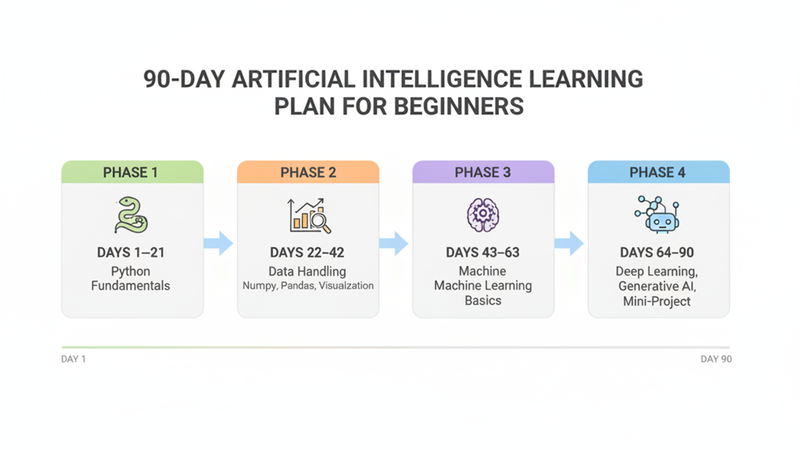
Your 90-Day AI Learning Plan (A Blueprint)
This is an aggressive plan, assuming consistent effort (10-15 hours/week).
Days 1-21 (Week 1-3): Python Mastery. Focus on core Python, data structures, functions, and basic OOP. Solve coding challenges daily.
Days 22-42 (Week 4-6): Data Handling with NumPy & Pandas. Work on cleaning and manipulating diverse datasets. Create visualizations with Matplotlib/Seaborn.
Days 43-63 (Week 7-9): Machine Learning Core. Understand supervised and unsupervised learning. Implement simple models with scikit-learn.
Days 64-90 (Week 10-12): Deep Learning & GenAI Fundamentals + Mini-Project. Get comfortable with TensorFlow/Keras or PyTorch. Explore prompt engineering. Start a small, focused project (e.g., image classifier or basic GenAI text generator).
After 90 days, you'll have a strong foundation. The next phase involves deeper dives into specific ML/DL areas, more complex projects, and continuous learning.
The Fastest Way to Start Building AI
Navigating the setup process, installing libraries, and configuring environments can be a major hurdle for beginners. This friction often discourages learners before they even write their first line of AI code.
This is where platforms like InfraOne School of AI can accelerate your learning. With browser-based AI Labs, you can jump straight into coding without any setup headaches. Our guided projects provide hands-on experience, ensuring you apply concepts immediately. Plus, with mentor support, you're never stuck, getting personalized guidance when you need it most.
InfraOne School of AI is designed to be the fastest way to start building AI, providing a structured path from beginner to builder, without the typical frustrations of environment setup.
Conclusion
Learning AI from scratch in 2026 is an achievable goal with the right roadmap and dedication. Start with Python, build your data handling skills, understand machine learning, explore generative AI, and most importantly, build projects. Avoid common pitfalls, stay consistent, and leverage resources designed to make your journey smoother. The future of AI is bright, and with this roadmap, you're well on your way to becoming a part of it.


-400x300.png) Jai Jha· 26 Jul 2026· 9 min read
Jai Jha· 26 Jul 2026· 9 min read

-400x300.png)