Landing an AI engineering role in 2026 demands a portfolio that goes beyond a simple collection of GitHub repositories. Recruiters are looking for evidence of end-to-end problem-solving, not just isolated coding skills. They want to see how you think, how you build, and how you communicate the value of your work.
This article will guide you through constructing an AI portfolio that addresses these expectations. You'll learn what makes a portfolio credible, the types of projects to include, and how to present them effectively. We'll cover everything from defining problems and demonstrating solutions to deployment, documentation, and business communication. By the end, you'll have a clear framework to audit your existing portfolio and identify impactful projects to build.
Many aspiring AI engineers mistake a GitHub profile full of code for a portfolio. A project collection is just that: a set of projects. A portfolio, however, is a curated narrative of your skills, showcasing not just what you built, but why and how it solves a real problem. It demonstrates your ability to take a project from concept to deployment, articulate your decisions, and understand the business impact.
Recruiters spend limited time on each application. They need to quickly grasp your capabilities. A well-structured portfolio makes their job easier by highlighting your strengths and aligning them with their needs.
Feature | Weak Portfolio (Project Collection) | Credible Portfolio (True Portfolio) |
|---|
Focus | Code for the sake of coding; often tutorial recreations | Problem-solving; end-to-end project lifecycle |
Demonstration | Static code files; screenshots sometimes | Live demo, interactive app, video walkthrough |
Problem Scope | Ill-defined, academic, or trivial problems | Clearly defined, real-world problems with context |
Technical Depth | Basic implementation of algorithms | Thoughtful architecture, technical trade-offs, scalability |
Evaluation | No metrics, or basic accuracy/loss scores | Comprehensive evaluation, failure analysis, ethical considerations |
Deployment | Absent or rudimentary local setup | Cloud deployment, API endpoints, user interface |
Documentation | Minimal README, inline comments | Clear README, design docs, user guides |
Communication | Technical jargon only | Explains technical concepts to non-technical audiences, business impact |
Originality | Copy-pasted solutions | Unique approaches, personal contributions |
Every impactful AI project starts with a well-defined problem. Recruiters want to see that you understand the context and implications of the challenge you're addressing. Avoid vague statements like "I built an image classifier." Instead, articulate the specific pain point or opportunity.
Example: Instead of "Image classifier for cats and dogs," try "Developed a real-time image classification system to identify stray animals in urban environments, assisting local animal welfare organizations in faster rescue operations." This shows purpose, context, and potential impact.
Your problem definition should include:
- The 'Who': Who experiences this problem?
- The 'What': What is the core issue?
- The 'Why': Why is this problem important to solve? What are the current limitations or inefficiencies?
- The 'How': How might AI offer a unique solution?
This is non-negotiable. Recruiters don't want to clone your repo, install dependencies, and run your code. They want to see it in action, immediately. A working demonstration is your project's resume. It can be:
- A live web application: The gold standard. Deploy your model as an API and build a simple frontend (e.g., using Streamlit, Gradio, Flask, or React).
- An interactive notebook: A Colab or Kaggle notebook with clear execution steps and visible outputs.
- A video walkthrough: A concise screen recording (2-3 minutes) demonstrating key functionalities and results. This is especially useful for complex projects or those without a web interface.
- API endpoint: For backend-focused roles, provide an accessible API endpoint with example cURL requests and expected responses.
Ensure your demonstration is stable, user-friendly, and highlights the core functionality of your solution. If it's a web app, make sure it's hosted reliably (e.g., on Hugging Face Spaces, Render, AWS EC2, or Google Cloud Run).
Recruiters want to understand your thought process. Simply stating you used a ResNet-50 isn't enough. Explain why you chose it. This section demonstrates your technical depth and ability to make informed decisions.
Discuss:
- Model Selection: Why did you choose a particular model (e.g., CNN, Transformer, GAN, LLM fine-tune)? What were the alternatives, and why did you rule them out?
- Data Preprocessing: What techniques did you apply? (e.g., augmentation, normalization, tokenization, feature engineering). Why were these necessary?
- Frameworks and Libraries: Justify your choices (e.g., TensorFlow vs. PyTorch, FastAPI vs. Flask, Hugging Face Transformers).
- Infrastructure: If deployed, describe the cloud services used (e.g., S3 for storage, EC2 for compute, Lambda for serverless, Kubernetes for orchestration). Why were these chosen over others?
- Trade-offs: Acknowledge the compromises you made (e.g., accuracy vs. inference speed, cost vs. scalability, complexity vs. maintainability). This shows maturity.
Use diagrams (even simple ones) to illustrate your system architecture. This significantly aids understanding.
Data is the bedrock of AI. Show you understand its importance and limitations. This section demonstrates your awareness of data ethics and practical data handling.
Include:
- Data Source: Where did the data come from? (e.g., Kaggle, proprietary dataset, web scraping).
- Data Characteristics: What kind of data is it? (e.g., images, text, tabular). What are its key features, size, and distribution?
- Preprocessing Steps: Detail any cleaning, transformation, or sampling applied.
- Bias and Limitations: Critically analyze potential biases in your dataset. Are there any ethical concerns? What are the limitations of your data?
- Privacy and Security: If dealing with sensitive data (even simulated), discuss how you handled privacy (e.g., anonymization, synthetic data generation, access controls).
Recruiter's Insight: "An AI engineer who understands data provenance, quality, and potential biases is far more valuable than one who only knows how to run model.fit()."
This is where many junior portfolios fall short. Simply stating "accuracy was 92%" is insufficient. Demonstrate a robust understanding of model evaluation and improvement.
- Metrics: Choose appropriate metrics beyond just accuracy (e.g., precision, recall, F1-score, AUC-ROC for classification; RMSE, MAE for regression; BLEU, ROUGE for NLP). Explain why these metrics are relevant to your problem.
- Experimentation: Describe the experiments you ran (e.g., hyperparameter tuning, different model architectures, ablation studies). Show your iterative process.
- Error Analysis: Crucially, analyze where and why your model fails. Provide examples of misclassifications or poor predictions. What insights did you gain? How would you improve it?
- Ethical Considerations: Discuss the potential societal impact of your model, both positive and negative. How did you mitigate risks?
This section showcases your critical thinking, problem-solving skills, and commitment to building responsible AI.
Recruiters need to verify your work if they choose to. A reproducible setup ensures that anyone can run your code and get the same results. This demonstrates professionalism and good development practices.
- Dependency Management: Use
requirements.txt for Python projects or environment.yml for Conda. Specify exact versions. - Clear Instructions: Provide step-by-step instructions in your README on how to set up the environment, download data (if applicable), and run the code.
- Configuration: Externalize configuration parameters (e.g., API keys, file paths) rather than hardcoding them.
- Data Versioning: For larger projects, mention if you used tools like DVC (Data Version Control) or similar practices.
Knowing how to deploy an AI model is a highly sought-after skill. It bridges the gap between research and real-world impact. Even a simple deployment is better than none.
- Live Application Link: As mentioned in the demonstration section, a direct link to a hosted application is ideal.
- API Documentation: If you deployed an API, provide clear instructions on how to interact with it (e.g., cURL commands, Postman collection).
- Cloud Service Usage: Detail the specific cloud services (AWS, GCP, Azure, Hugging Face, Render) you used for hosting, inference, and potentially MLOps components.
- Monitoring (Optional but strong): If you implemented any basic monitoring for your deployed model (e.g., logging inference requests, tracking latency), mention it.
InfraOne School of AI provides browser-based labs that allow you to quickly experiment with and deploy AI models without complex local setups. This means you can focus on building and deploying your projects, gaining valuable experience for your portfolio.
Your README is the gateway to your project. It's often the first (and sometimes only) thing a recruiter reads. A well-written README is concise, informative, and acts as a project summary.
Key elements of a strong README:
- Project Title and Description: A clear, concise overview of what the project is and what problem it solves.
- Live Demo Link: Prominently display the link to your working demonstration.
- Key Features: A bulleted list of the main functionalities.
- Technical Stack: List the primary technologies, frameworks, and libraries used.
- Architecture Diagram: (Optional but highly recommended) A visual representation of your system.
- Setup and Installation: Clear, step-by-step instructions for local setup and dependency installation.
- Usage: How to run the application or interact with the API.
- Results and Evaluation: Summary of key metrics and findings.
- Future Work/Improvements: Shows you've thought beyond the current iteration.
- Contact Information: Your name and LinkedIn profile.
Beyond the README, consider adding more detailed documentation for complex projects, such as design documents, API specifications, or user guides.
Technical skills are essential, but the ability to articulate the business value of your work is what truly sets you apart. Recruiters want to see that you can translate technical jargon into tangible benefits.
In your portfolio, for each project, clearly state:
- The Business Problem: Reiterate the real-world problem you're solving.
- The AI Solution: Briefly explain how your AI model addresses this problem.
- The Impact: Quantify the potential benefits (e.g., "reduced processing time by 30%," "improved customer satisfaction by identifying key feedback trends," "saved X resources by automating Y task"). Even if theoretical, frame it in terms of business value.
- Target Audience: Who would benefit most from this solution?
This demonstrates that you understand the bigger picture and can contribute to an organization's strategic goals, not just its codebase.
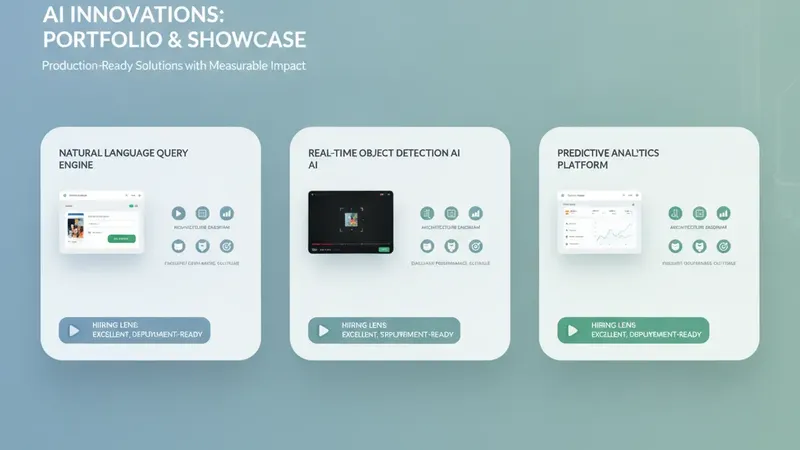
Instead of many unfinished or trivial projects, focus on three high-quality, diverse projects that showcase a range of skills. This structure allows you to demonstrate breadth and depth without overwhelming the recruiter.
Project Type | Focus Area | Evidence Required |
|---|
Core ML/DL Application | Deep dive into a specific ML/DL technique. | Clear problem, model architecture, rigorous evaluation, error analysis, deployment (even basic), well-documented. |
End-to-End System | Full lifecycle: data, model, deployment. | Data pipeline, API development, cloud deployment, monitoring, robust documentation, business impact. Generative AI is a strong fit here. |
Domain-Specific/Applied | Applying AI to a unique industry or problem. | Understanding of domain challenges, custom data handling, ethical considerations, stakeholder communication, problem-solving. |
Project # | Project Title | Primary Skills Demonstrated | Tools/Tech Stack | Focus |
|---|
1 | Real-time Crop Disease Detector (Mobile-first) | Computer Vision, Transfer Learning, Edge Deployment | PyTorch/TensorFlow Lite, Flask/FastAPI, Docker, Firebase/GCP App Engine, Android/iOS integration (concept) | End-toend solution for farmers, focusing on practical utility, low-latency inference, and potential for offline use. |
2 | Conversational AI for Customer Support (GenAI) | NLP, Large Language Models (LLMs), Fine-tuning, API Dev | Hugging Face Transformers, LangChain/LlamaIndex, FastAPI, AWS Lambda/GCP Cloud Functions, PostgreSQL | Building a custom chatbot capable of handling specific queries, demonstrating prompt engineering, RAG, and fine-tuning strategies. |
3 | Supply Chain Anomaly Detection | Time Series Analysis, Anomaly Detection, Data Engineering | Pandas, Scikit-learn, Prophet/ARIMA, Airflow/Prefect, Tableau/PowerBI (dashboard) | Identifying unusual patterns in logistics data to prevent disruptions, showcasing data processing, feature engineering, and visualization. |
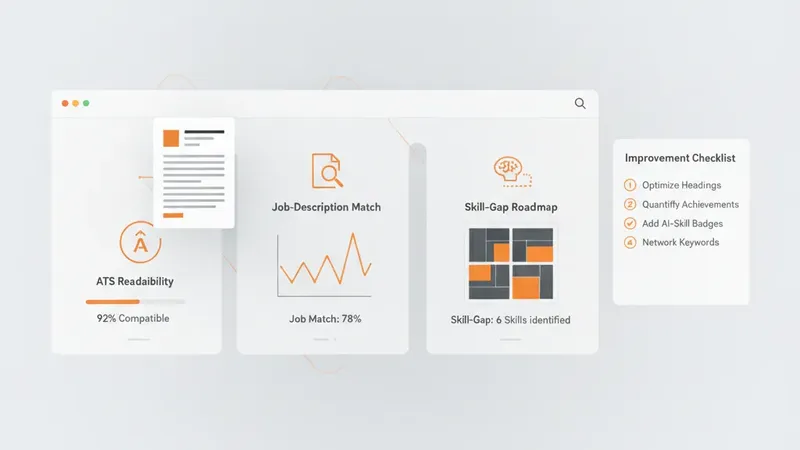
Use this scorecard to evaluate your existing projects or plan new ones. Be honest with yourself!
| Feature | Score (0-5) | Notes / Areas for Improvement paste for the | Business Communication is Key: Your ability to explain complex technical decisions in plain, business-oriented language is paramount. It shows that you understand the bigger picture and can bridge the gap between technical execution and strategic impact.
Building an AI portfolio for 2026 is an investment in your career. It requires thoughtful project selection, meticulous execution, and clear communication. Remember, recruiters are looking for problem-solvers who can deliver real value, not just coders. Focus on quality over quantity, demonstrate your end-to-end capabilities, and articulate the business impact of your work.
Start auditing your current projects against this framework. Identify gaps and plan to build impactful projects that showcase your unique skills. If you're looking to accelerate your practical skills and quickly build deployable projects, explore the hands-on labs and comprehensive courses at InfraOne School of AI. Our platform is designed to help you gain the experience necessary to craft a truly compelling AI portfolio.


-400x300.png) Jai Jha· 26 Jul 2026· 9 min read
Jai Jha· 26 Jul 2026· 9 min read
-400x300.png)